

This page contains the following Educational ECG Videos that may be of interest to you:
- 1) Watch Your Ps, Qs, 3Rs (Systematic Approach to Rhythm Interpretation! )
- 2) Estimating Heart Rate (including when the rate is very fast! ).
- 3) From the XXXX post — with illustration of the Every-other-Beat Method for rapid estimation of fast heart rates — and How to look for subtle Flutter waves.
- 4a) User-Friendly Approach to ECG Dx of Bundle Branch Blocks!
- 4b) Brugada ECG Patterns …
- 5) Aberrant Conduction (LINK to my review of the Ashman phenomenon).
- 6) Laddergram Basics (How to quickly learn to read a Laddergram )
- 7) The 3 Types of AV Dissociation vs Complete AV Block.
- 8) MAT (Multifocal Atrial Tachycardia) vs WAP (Wandering Atrial Pacemaker).
= = =
— Where to find the ECG Videos LINK in the Top Menu —

= = =
= = = = = = = = = = = = = = = = = = = = = = = = = = = = =
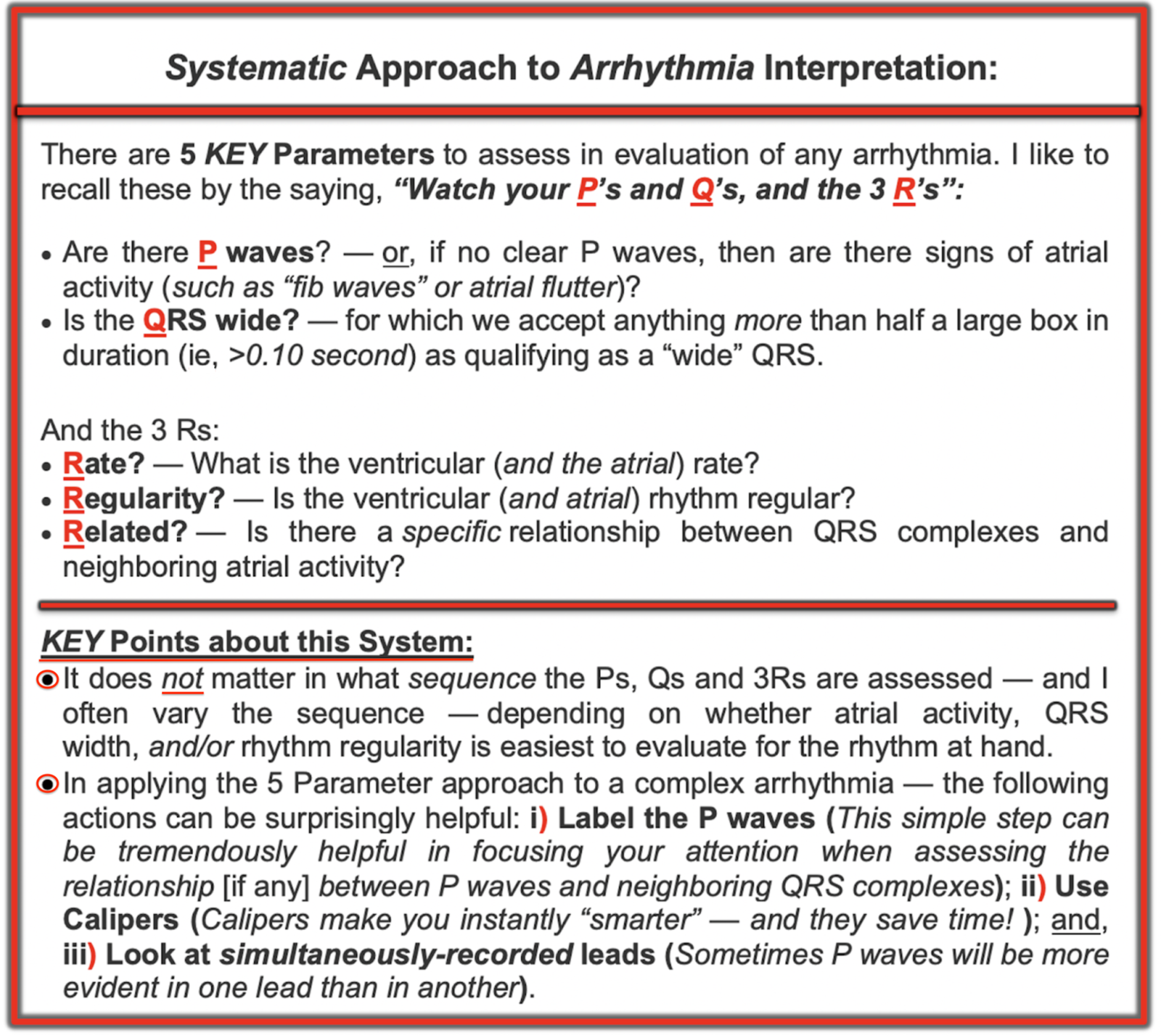
1) Watch Your Ps, Qs, 3Rs (Systematic Approach to Rhythm Interpretation! )
- In this 2:30-minute video (67MB- mp4– 10/27/2025) — I quickly review my user-friendly Systematic Approach to rhythm interpretation that will: i) Speed Up your interpretations; ii) Increase your accuracy; — and, iii) Narrow your differential diagnosis, as well as allowing you to sound intelligent — even if you are not certain what the rhythm is.
= = =
2) Estimating Heart Rate, including when the rate is very Fast! (by Ken Grauer — from the Augst 13, 2025 post).
- I begin this 3-minute video with the basics for how to estimate the rate of any fast or slow rhythm.
- NOTE: For review on how to estimate fast heart rates — Skip to 1:25 minutes in this video, when I show how quickly and accurately apply the Every-other-Beat Method!
= = =
3) This 2:30 minutes video is from the XXXXX post (WCT in an 85yo) — in which I illustrate use of the Every-other-Beat Method for rapid estimation of fast heart rates — and beginning at 1:05 minutes in the video, How to look for 2:1 flutter waves (XX MB- mp4– 10/28/2025).
= = =
4a) User-Friendly Approach to ECG Dx of Bundle Branch Blocks! (How to Dx the BBBs in seconds! ).
- In this 13-minute video (90MB- mp4) — I simplify rapid diagnosis of the type of Bundle Branch Block by focus on the 3 KEY Leads ( = leads I,V1,V6 ) — allowing you to distinguish between LBBB vs RBBB vs IVCD in less than 5 seconds!
= = =
4b) Brugada ECG Patterns . . .
- We’ve presented lots of examples of Brugada ECG Patterns in Dr. Smith’s ECG Blog (See the XXXX post — the XXX post).
- I recently published this case HERE — in which I review Brugada ECG Patterns in the context of a middle-aged man who presented with new CP (Chest Pain) — and the 12-lead ECG shown below (My 2-part ECG Videos reviewing Brugada ECG Patterns below).
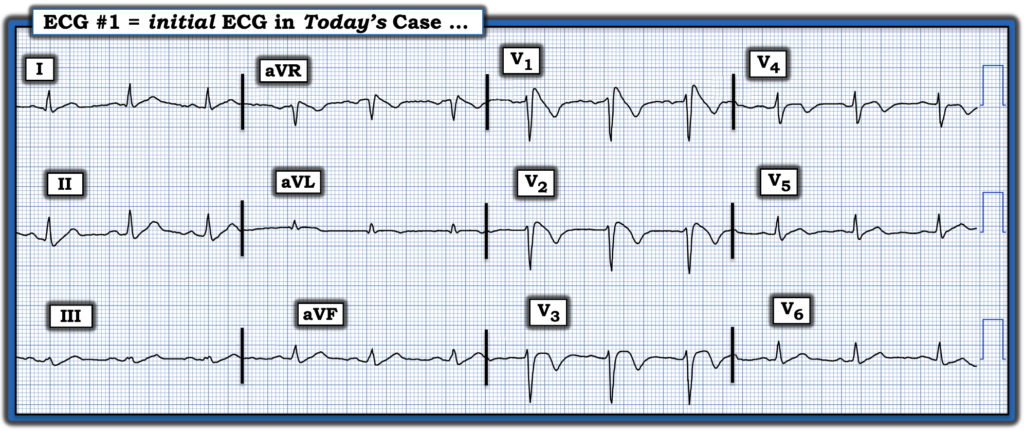
Below: Part 1 (9 minutes- 81MB/mp4)and Part 2 (8 minutes- 84MB/mp4) ECG Videos on Brugada ECG Patterns.
= = =
===
5) The “Whys” of Aberrant Conduction
- In this 4:45 Minutes video (63 MB- mp4) — I review WHY some early beats and some SVT rhythms are conducted with Aberration (and why the most common form of aberrant conduction manifests RBBB morphology).
- NOTE: In addition to QRS morphology and the coupling interval of early beats — is the effect of the R-R interval preceding the wide beat (which with bradycardia, predisposes to aberrant conduction by prolonging the refractory period of the next beat). I review this important additional concept with my user-friendly approach to the Ashman phenomenon (See My Comment at the bottom of the page in the September 16, 2024 post in Dr. Smith’s ECG Blog).
= = =
6) Laddergram Basics (How to quickly learn to read a Laddergram )
Learning to draw Laddergrams is challenging. I fully acknowledge that it took me significant time until I felt comfortable with this skill. That said — learning to read laddergrams is EASY — and important for enhancing your understanding of more complex arrhythmias.
- I cover the basics of what a laddergram is in the 5-minute ECG Video below. With this as introduction — you should be able to understand the mechanism portrayed in most laddergrams you will see (85MB- mp4) .
- NOTE: You do not need to know how to draw laddergrams in order to attain excellence in arrhythmia interpretation — BUT — Becoming comfortable in reading laddergrams will be invaluable for taking you to your next level!
- For more on Laddergrams, with lots of examples! — CLICK HERE !
= = =
7) The 3 Types of AV Dissociation vs Complete AV Block:
- In this 4:45 minutes video (54 MB– mp4) — I review the 3 Causes of AV Dissociation and distinguish between AV Dissociation vs Complete AV Block.
= = =
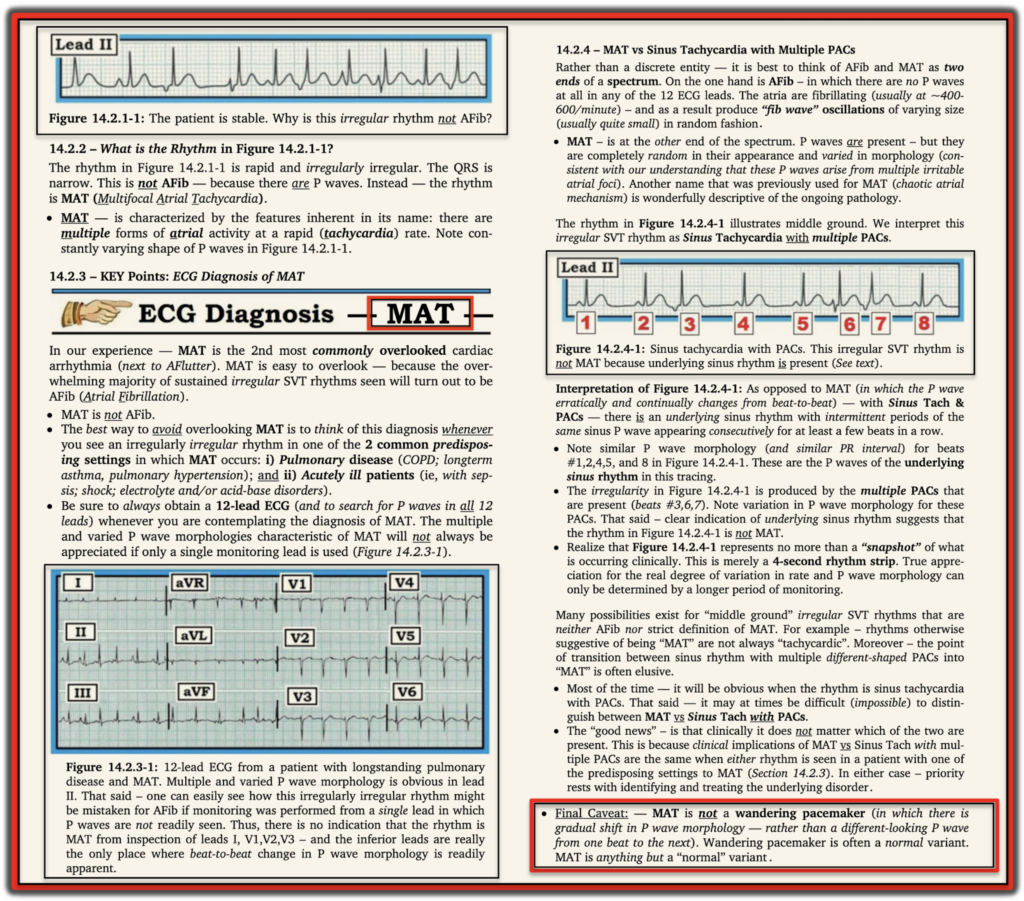
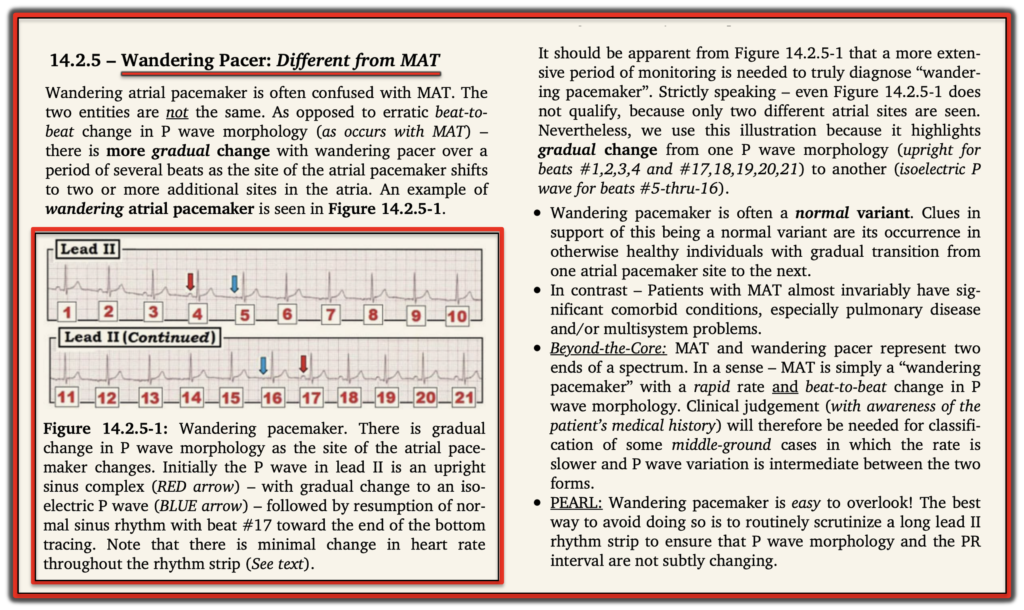
8) MAT (Multifocal Atrial Tachycardia) vs WAP (Wandering Atrial Pacemaker):
- In this 3:25 minutes video (85 MB– mp4) — I review what MAT is — and how it is distinguished from a wandering pacemaker.
= = =
- In this 3:30 minute Audio Pearl — I review what WAP is.
Below are 1-page summaries on MAT and WAP (from Grauer K: 2013 ACLS/Arrhythmia ePub).
9) XXXX
XXXX
10) XXXX
XXXX