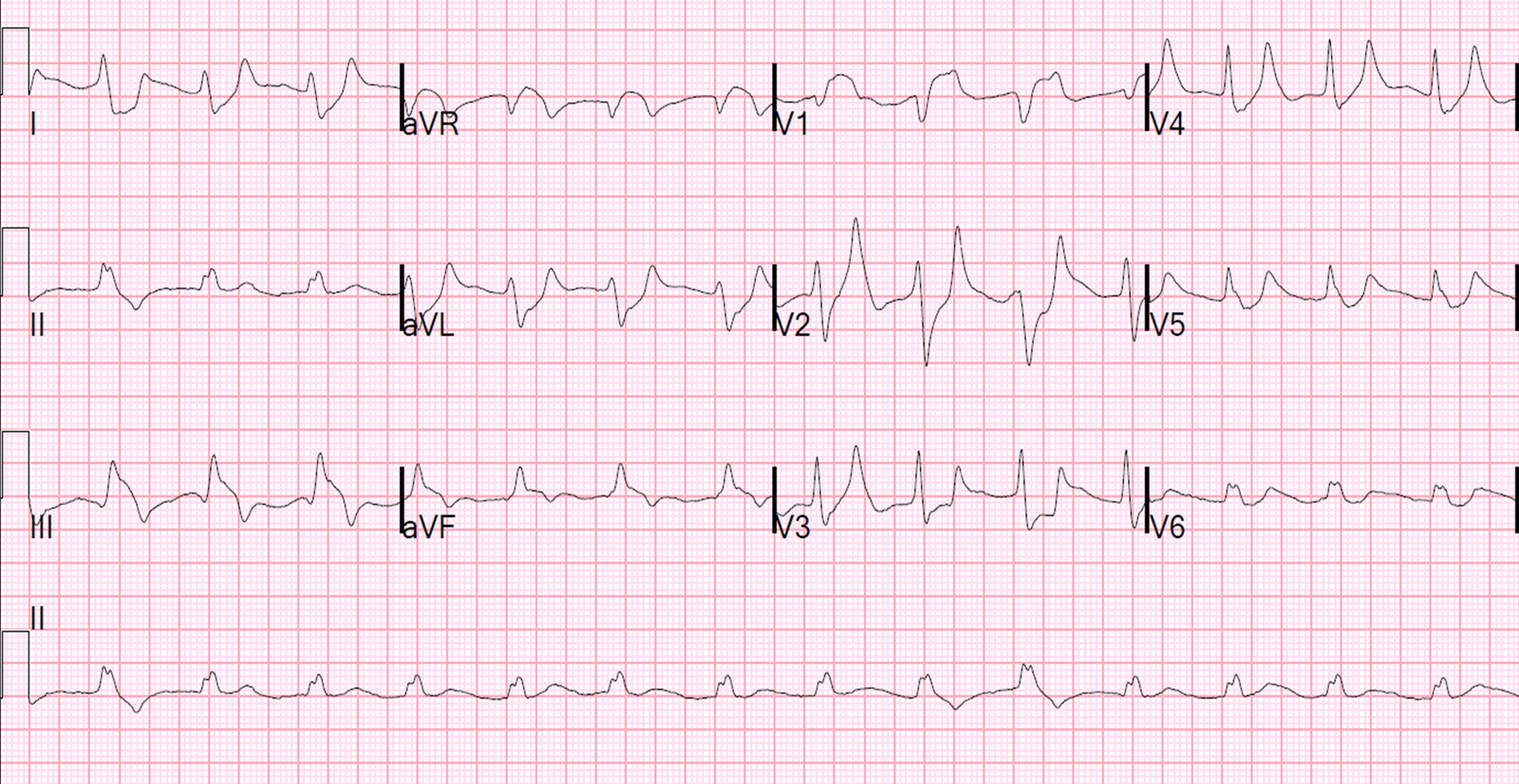
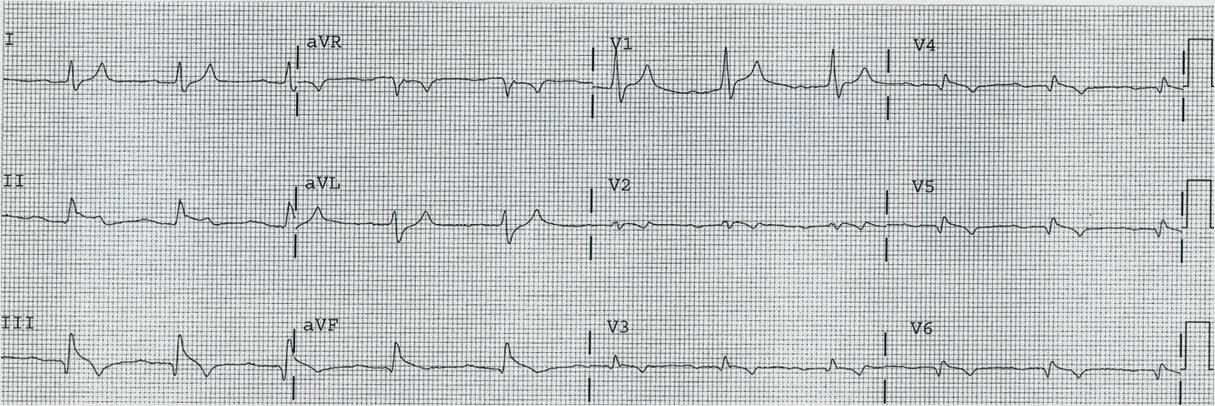
A male in his 30’s male complained of chest pain while having a dental procedure, then became syncopal. The patient is young and healthy, and thin. He had no past medical history. In the ED, he felt and looked fine, with normal vital signs and no chest pain.
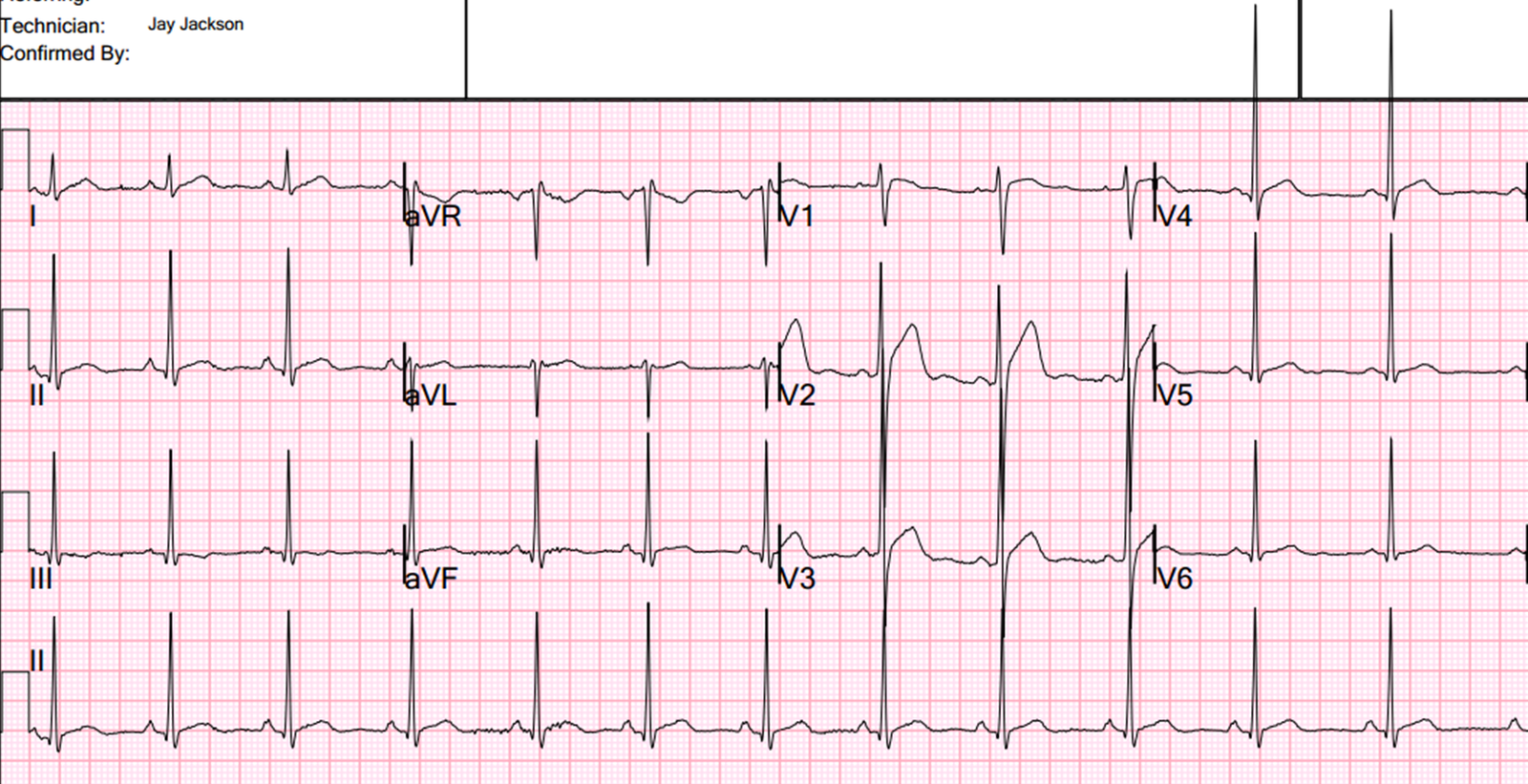 |
| Sinus rhythm. High voltage. The computerized QTc is 390 ms. There is 4 mm of ST elevation in lead V2, and 1.5 mm in V3 (at J-point, relative to PQ junction). There are straight ST segments in V2 and V3, which suggest STEMI. However, the voltage is very high and the QT is relatively short. |
In this case, the ST elevation does meet the standard STEMI “criteria” (see below) because there is 1 mm in V1 and 4 mm in V2, even though there is only 1.5 mm in V3.
Strictly speaking, the early repol vs. anterior STEMI formula should not be used because the ST segments are non-concave (i.e., straight, though not upwardly convex). Nevertheless, if it is used, the result is 17.4, which is very low.
From reference 1: At least 2 Consecutive Leads With ST elevation of:
V1, V4-V6: 1 mm
V2, V3: for men over 40 yo: 2 mm
for men under 40 yo: 2.5 mm
for women, any age: 1.5 mm
A repeat ECG 2 hours later was unchanged. The patient was discharged.
Diagnosis: Early repolarization with high voltage in young healthy patient with a thin chest wall. Syncope due to vasovagal event (neurocardiogenic syncope) in dentist’s chair.
1. Wagner GS, Macfarlane P, Wellens H, et al. AHA/ACCF/HRS recommendations for the standardization and interpretation of the electrocardiogram: part VI: acute ischemia/infarction: a scientific statement from the American Heart Association Electrocardiography and Arrhythmias Committee, Council on Clinical Cardiology; the American College of Cardiology Foundation; and the Heart Rhythm Society. Endorsed by the International Society for Computerized Electrocardiology. J Am Coll Cardiol. 2009;53:1003-1011.