Dr. Smith's ECG Blog

Instructive ECGs in Emergency Medicine Clinical Content

Associate Editors:
— Pendell Meyers & Ken Grauer (2018)
— Jesse McLaren & Emre Aslanger (2022)
— Willy Frick (2024) — Sam Ghali (2025)

editors

A Mystery Rhythm, Explained by K. Wang’s Ladder Diagram.

This was presented at the SMACC-Gold EKG workshop:
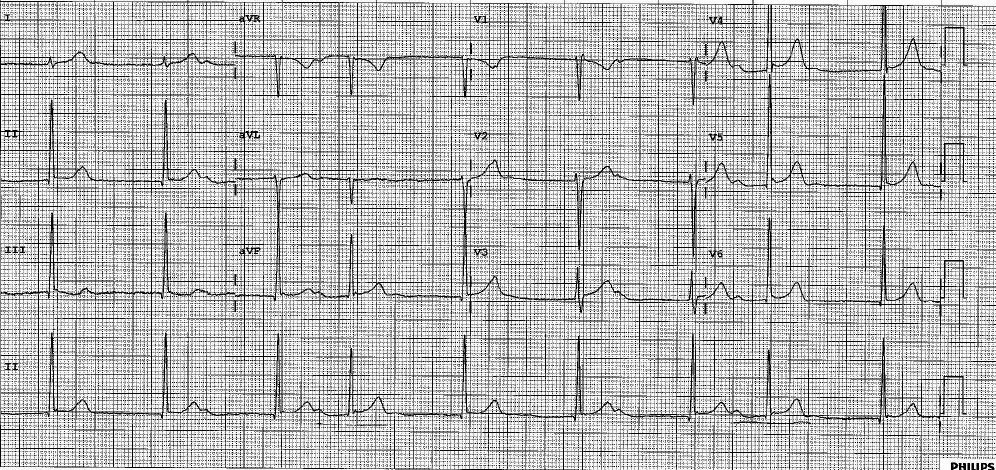
Can you figure it out?
See the answer below.

Here is a nice ladder diagram and explanation from K. Wang:

–The primary problem is irregular sinus bradycardia (sinus node
dysfunction), with junctional escape beats (R1, 2, 3, 5, 6, 7,and 9, which occur with exactly
the same interval) and two capture (conducted) beats (R4 and 8). 

–The patient also
must have some degree of AV conduction problem both anterograde and retrograde.
Otherwise, R2, 3, 6, and 7 would have resulted in retrograde P waves, or P2 and 5
would have conducted. 

–P3 and 6 occur with slightly longer RP interval than P2 or 5, which is the reason why they are conducted but still with a long PR interval.

–P1, 4, and 7 are completely assumed even though it is unusual for
them to occur exactly within the QRS (too much of coincidence). Otherwise, P3P5
interval is too long not to have a P wave in between when P2P3 or P5P6 can
occur.

Previous Article

Diffuse ST Elevation. What do you think?

Next Article

Is it Wellens' Syndrome?