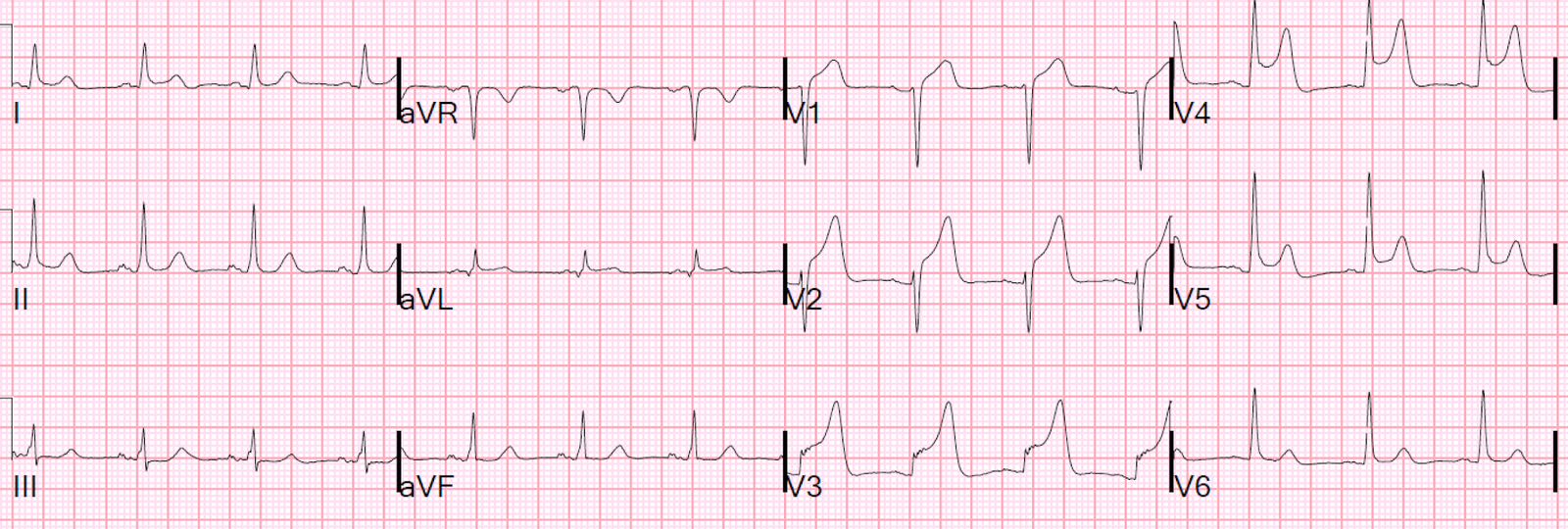
A patient presented with weakness. He was found to be bradycardic, so this ECG was recorded:
 |
| There is atrial flutter with 3rd degree AV block and Left ventricular escape. Why is it not slow AV conduction with RBBB? The QRS occurs at different points on the flutter wave. There is complete dissociation due to complete AV block. |
More history
The patient has a history of congenital heart disease repaired as a child. He reports having had an extra pacemaker transiently but this was removed at a very young age. The patient describes a history of progressive bradycardia. In recent years, the patient states that his heart rate has generally been in the 30s.
The patient states that he developed a gastrointestinal illness in recent days. This was associated with nausea and recurrent episodes of vomiting. He had decreased oral intake. The patient describes having taken potassium supplementation in recent days. Today, the patient became increasingly lightheaded. He took his pulse and felt that it was in the teens. He presented to the emergency department for further evaluation.
In the emergency department, the patient’s heart rate was between 10 and 15. EKG revealed atrial flutter with junctional rhythm. Laboratory studies revealed an elevated creatinine at 2.9 mg/dL and a K of 5.4 mEq/L.
What is the best first ED treatment? See below.
The patient has had bradycardia for years, but never this bad. He clearly has chronic AV block, but why did it get so bad right at this moment?
Because his gastrointestinal illness led to renal insufficiency, which with K supplementation led to mild hyperkalemia of only 5.4 mEq/L, which was just high enough to tip him over the edge.
The best fast treatment is to treat hyperK with Calcium, insulin and glucose, and possibly bicarbonate. One may add beta-2 agonists:
Terbutaline and Albuterol for Lowering of Plasma Postassium
The patient clearly needs a permanent pacemaker, but only needs an emergent ED pacemaker if treatment of hyperK does not work.