The OMI
Manifesto

A collaboration by Dr.
Smith’s ECG Blog and EMCrit
Pendell Meyers, MD
Scott Weingart, MD, FCCM
Stephen Smith, MD
The current guideline-recommended paradigm of acute MI
management (“STEMI vs. NSTEMI”) is irreversibly flawed, and has prevented
meaningful progress in the science of emergent reperfusion therapy over the
past 25 years. Dr. Stephen Smith, my mentor and co-editor of this post, has
been saying this much more eloquently for many years in his “STEMI/NSTEMI False Dichotomy”
lecture series, but this bears repeating and needs to be
reiterated as widely as possible.
Deciding which patients need emergent reperfusion therapy is
complex, and our current criteria for doing so are not adequate to the task.
The patients who benefit from emergent catheterization are those with acute
coronary occlusion (ACO) or near occlusion, with insufficient collateral
circulation, whose myocardium is at imminent risk of irreversible infarction
without immediate reperfusion therapy. This is the anatomic substrate of the
entity we are supposed to refer to as “STEMI.” Unfortunately the term
“STEMI” restricts our minds into thinking that ACO is diagnosed
reliably and/or only by “STEMI criteria” and the ST segments. In
reality, the STEMI criteria and widespread current performance under the
current paradigm have unacceptable accuracy, routinely missing at least 25-30%
of ACO in those classified as “NSTEMI”1-9 and
generating a similar false positive rate of emergent cath lab activations.10-12
The STEMI-NSTEMI paradigm was the best idea available in
2000, when it formally replaced the Q-wave vs. Non-Q-wave MI paradigm.13 This
paradigm shift was prompted by the Reperfusion Era, in which multiple large
randomized controlled trials proved the efficacy of emergent reperfusion
therapy.14 More specifically, nearly 60,000 ACS
patients were randomized to thrombolytics vs. placebo, showing an impressive
mortality benefit of NNT=56 for entire cohort given thrombolytics, despite the
fact that 4 of the 9 trials had no ECG inclusion criteria whatsoever, and
one-third of the patients had no appreciated STE. In the subgroup with
undefined STE, lytics showed an even greater mortality benefit of NNT=43. This
means that STE predicted ACO (and thus mortality benefit) better than not
looking at the ECG at all. However, thanks to Dr. Smith and others we have
learned a great deal about expert ECG interpretation since the 1994 FTT
meta-analysis, and it turns out STE is no longer our best option for predicting
ACO and therefore of the benefit from emergent reperfusion.
To anyone who has spent time seeing patients and studying the
ECGs and angiograms of acute MI, it is obvious why the STEMI criteria routinely
fail in both directions. Foremost, ACO is a complex and dynamic process that
doesn’t always manifest any ECG changes at all. When it does manifest ECG
changes, it is an intricate and time-sensitive progression of changes,
exquisitely sensitive to reperfusion and reocclusion. The earliest stages of
ACO (when the benefit of intervention is maximal) routinely do not show any
STE. Even if you are lucky (or wise) enough to obtain an ECG during the ST
segment changes, STE is always proportional to the size of the QRS complex,
which may be very small in some territories with low voltage on the surface ECG
such as the high lateral wall. Furthermore, not all ACOs produce STE, some result
only in changes in the QRS or T-wave, or no ECG findings at all. This may be
due to a variety of causes: time of recording (including during a brief period
of spontaneous reperfusion), “electrocardiographically silent” myocardial
territory, small myocardial territory, and low QRS voltage. Meanwhile, a huge
proportion of controls without acute coronary syndrome have normal variant STE,
or have abnormal depolarization (LVH for a common example) generating
appropriate repolarization abnormalities which frequently meet STEMI criteria.
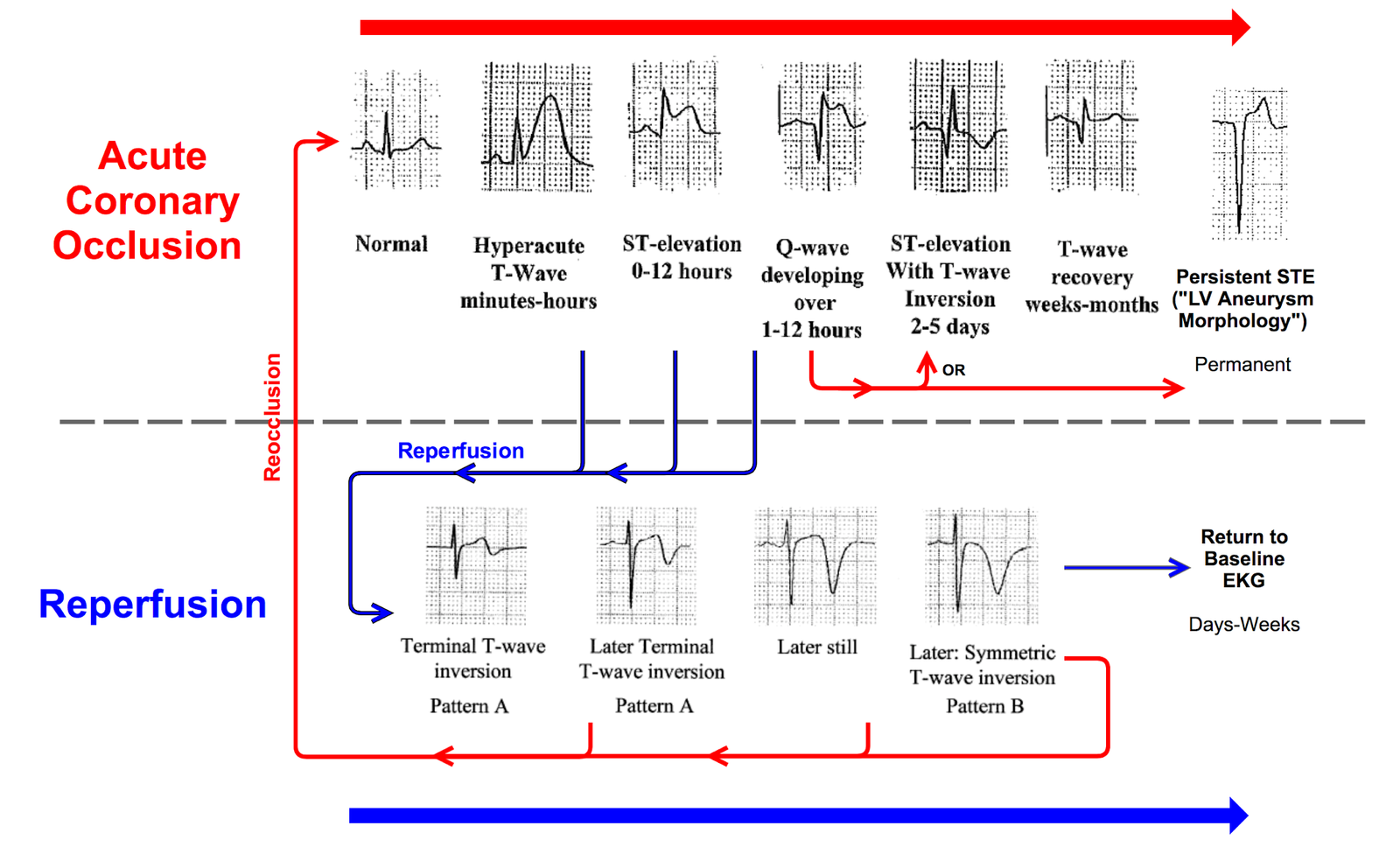 |
|
The progression of ECG findings seen during acute coronary occlusion and reperfusion. |
In an attempt to spread this knowledge without challenging the
deeply ingrained “STEMI vs. NSTEMI” paradigm, terms such as “STEMI equivalent”
and “subtle STEMI” and “semiSTEMI” have been created and discussed for years in
the literature. Sadly, these attempts have not produced widespread change in
perception or management of acute MI except in the small groups of clinicians
who have special interest in following such literature or the various FOAM
resources that broadcast this knowledge.
For too long we have tried to keep the familiar, catchy, and
beloved term “STEMI” in the name, when in reality the name itself is part of
the problem. The term “STEMI” cognitively inspires us to think that only the ST
segments matter, that the ST segments are reliable and don’t depend on the
preceding QRS complex, and that STE on the ECG is the only necessary data point
for making the reperfusion decision. If we want progress on a larger scale in
the management of acute MI, we will be forced to break from the current
paradigm. While some have suggested a requiem for “unstable angina” (an entity
that is alive and well), we should instead nominate for a requiem the dangerous
and uniquely brainwashing term STEMI. For 25 years it has restricted our
thinking, prevented further research from showing who actually benefits from
emergent reperfusion, and blinded us to how much better we can do for our
patients whose myocardium is actively infarcting under our care. “Is the
patient having a STEMI?” must eventually be replaced with something that
reminds us of the real question we should be asking: “Does the patient
have an acute coronary occlusion that would benefit from immediate
intervention?” To accomplish these goals, we propose the term “OMI” as
an alternative:
OMI = Occlusion
Myocardial Infarction
NOMI = Non-Occlusion Myocardial Infarction
To learn the history, literature, and experience that
supports these views, as well as the reasons we propose OMI, follow the link below to the full PDF manuscript of the OMI Manifesto……………………
This is a detailed document with many references that are described in detail: