Dr. Smith's ECG Blog

Instructive ECGs in Emergency Medicine Clinical Content

Associate Editors:
— Pendell Meyers & Ken Grauer (2018)
— Jesse McLaren & Emre Aslanger (2022)
— Willy Frick (2024) — Sam Ghali (2025)

editors

The development of an inferior-posterior STEMI, from prehospital to hospital

For other cases of inferior hyperacute T-wave click here and here.

For more on lead aVL, click here and here.  Also use labels on the right sidebar.

Case

A 65 yo woman called 911 for pain in her upper back (between the shoulder blades) and in the left shoulder and left biceps, and some “mild chest pressure” elicited by the medics.  Exam was normal. All but the back pain resolved with nitroglycerine

Medics recorded 6 prehospital ECGs.  Below are 3 of them:

1430
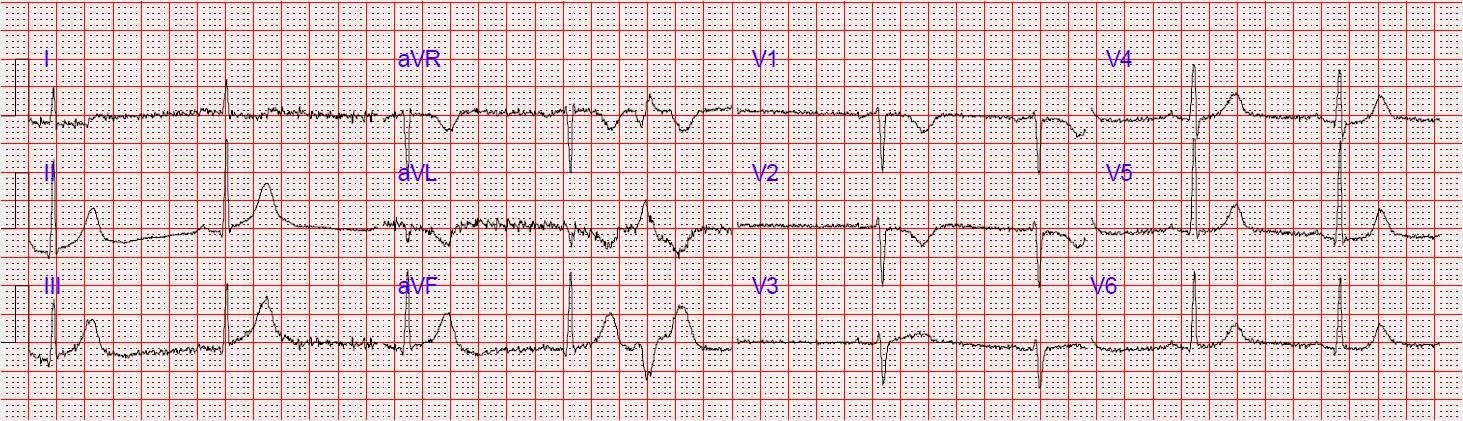
There are hyperacute T-waves in II, III, and aVF.  Note T-wave inversion in aVL, which is the earliest finding in acute inferior STEMI, as well as in V2, suggesting posterior wall involvement

 1432

No significant change

 1445

Now there is clear ST elevation in inferior leads.  T-wave inversions in aVL and V2 have evolved to ST depression.  

They arrived in the ED at 1503.  BP was 116/70.  CXR and cardiac and aortic ultrasound were done to look for any evidence of aortic dissection.  All were normal except for a possible inferior wall motion abnormality.

In the ED, the following ECGs were recorded. 

1512

ST segments have almost normalized. Hyperacute Ts are less prominent, as is T inversion.  There is probably some spontaneous reperfusion of the infarct-related artery.  The computer noticed only some “minimal” ST depression.

1532

Inferior ST elevation is more obvious, with 1 mm in II and III, but T-waves have normalized.  ST depression in V2 is clearly abnormal.  Computer did not read MI.

1542

Now the most obvious findings are ST depression in aVL and V2

Cardiology was consulted.  Again, a cardiology fellow opined that this was not a STEMI, and went to talk with the interventionalist. 

A posterior ECG was recorded:

Only aVL was of great concern.  There is no posterior ST elevation.

The interventionalist was very concerned and activated the cath lab.  The patient was taken to the cath lab.  The proximal RCA was 100% occluded.  It was stented.  Door to balloon time was 62 minutes.  Peak troponin I was 5.15 ng/ml.

Post PCI ECG
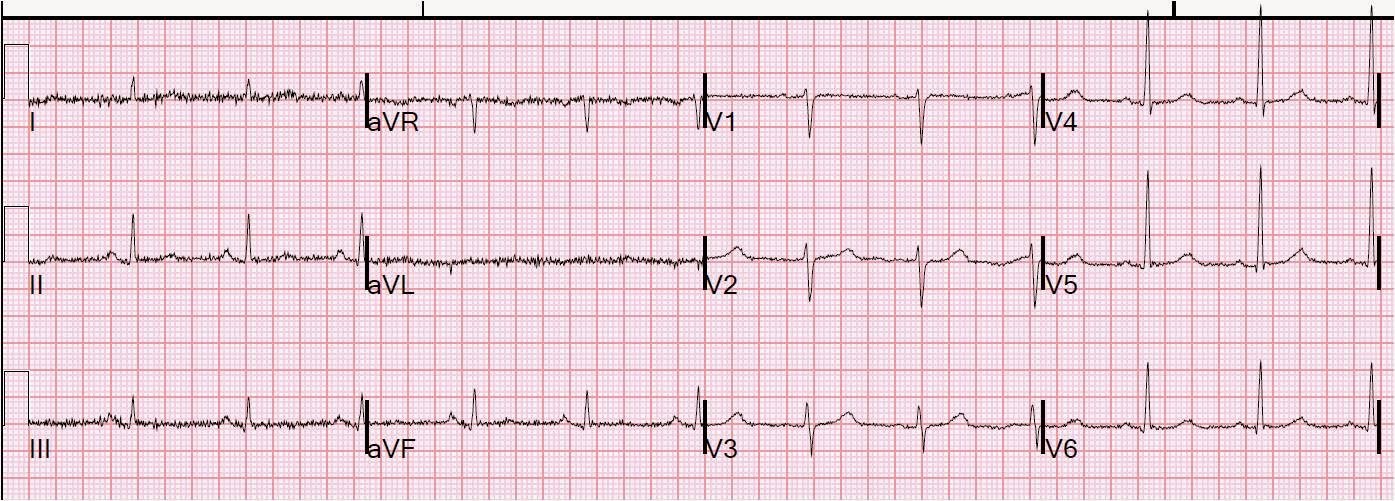
T-waves and ST segments are back to normal

Previous Article

Chest pain and LBBB. LBBB resolves and there is V1-V3 T-wave inversion.

Next Article

Transient STEMI, serial ECGs prehospital to hospital, all troponins negative (less than 0.04 ng/ml)