==================================
MY Comment, by KEN GRAUER, MD (9/9/2026):
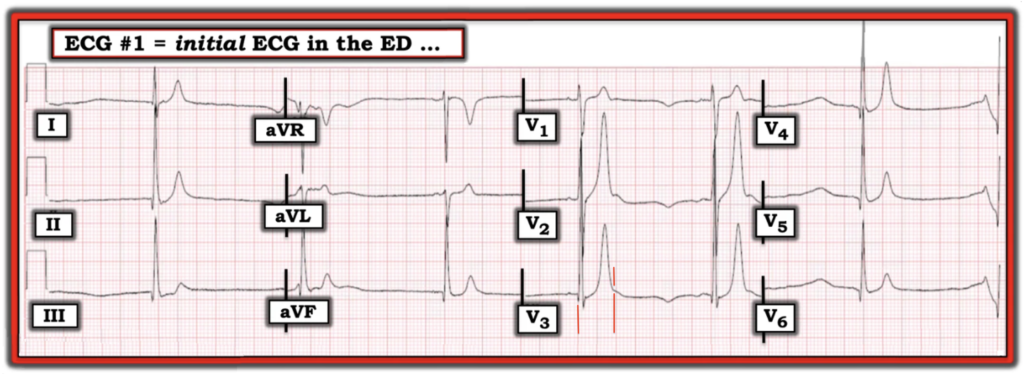
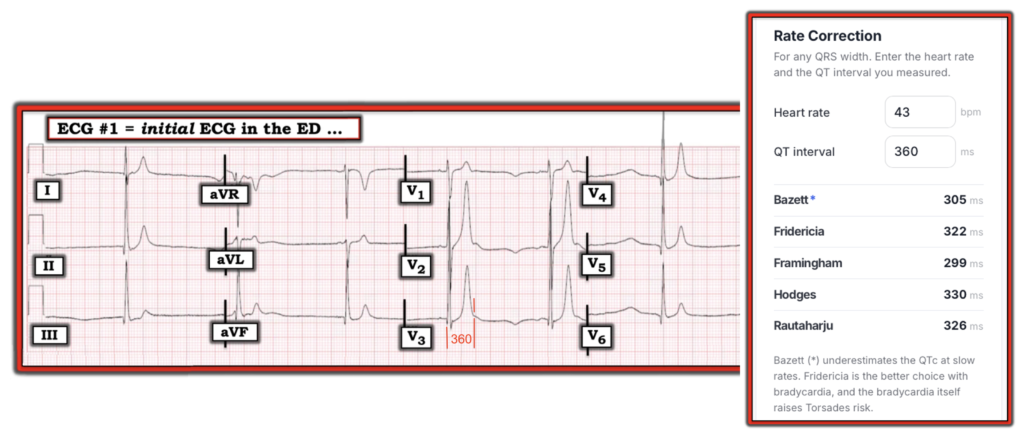
I’ve excerpted the tracing in Figure-1 from the September 2, 2019 post — because this ECG illustrates a telling story. What is the diagnosis?
- Hint #1: This patient does not have hyperkalemia!
- Hint #2: Why did I draw the vertical RED lines in lead V3?
= = =
Figure-1: What is the diagnosis?
= = =
ANSWER:
Once we know that the serum K+ level was normal — We can focus on those vertical RED lines in lead V3. These lines delineate the longest QT interval that we can confidently measure on this 12-lead tracing.
- I thought the longest QT interval that I could clearly measure was in either lead V2 or V3. I measured 360 ms (thin vertical RED lines in V3 showing from where I measured).
- The R-R intervals both preceding and including this longest measured QT interval correspond to a heart rate of ~43/minute.
= = =
My real purpose in reposting this tracing — is to highlight our QTc Calculator. We have just updated and improved this useful tool, that for ready reference we show in the TOP menu of every page in Dr. Smith’s ECG Blog under Tools & Guides ==> CLICK HERE —
- Inserting my measured QT = 360 ms at a rate of ~43/minute — quickly allows us to calculate the QTc for the 5 most commonly used QTc formulas.
- As can be seen in Figure-2 — all 5 calculated QTc values satisfy the threshold of ≤330 ms for males as qualifying for SQTS (Short QT Syndrome).
= = =
Figure-2: Results of our QTc Calculator for today’s ECG.
= = =
P.S.: The complete and tragic story of this case by Pendell Meyers can be found on the September 2, 2019 post (which includes in My Comment at the bottom of that page — a brief review of the Short QT Syndrome with the millisecond QTc thresholds for diagnosing a “short” QTc, and the lower thresholds that qualify as true SQTS).
P.P.S.: Please TRY OUT our QTc Calculator (that for ready reference is accessible in the TOP menu of every page in Dr. Smith’s ECG Blog under Tools & Guides).
- We welcome your feedback on this QTc Calculator (Ken Grauer, MD — ekgpress@mac.com).
= = =
Smith: for lots of very interesting insights into long QT, QT measurement, and QT correction, see this post: QT Correction Formulas Compared to The Rule of Thumb (“Half the RR”) —
= = =
= = =