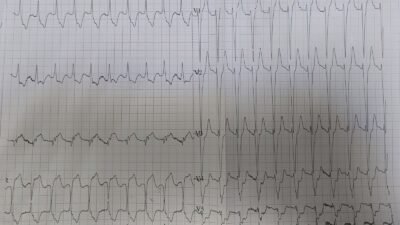
A 30-something was in the ED for some minor trauma when he was noted to have a fast heart rate. He acknowledged that he had palpitations. but only when asked. He had a history heavy alcohol use. Blood pressure was normal (109/83).
Here is his 12-lead:
 |
| There is a wide complex tachycardia with a rate of 257, with RBBB and LPFB (right axis deviation) morphology. |
The Differential Diagnosis is:
SVT with aberrancy(#)
[AVNRT vs. WPW (also called AVRT*)]
Atrial flutter with 1:1 conduction, with aberrancy
VT coming from the anterior fascicle (fascicular VT)@
*AVRT = AV Reciprocating Tachycardia (Tachycardic loop that uses both the AV node and an accessory pathway. Depending on whether the accessory pathway is unidirectional or bidirectional, this can go down the AV node and up the accessory pathway (orthodromic), or down the pathway and up the AV node (antidromic).
#Aberrancy means that the impulse coming from (AVNRT) or through (Orthodromic AVRT) the AV node is too rapid to allow for repolarization of all the conducting fibers. In this case, the right bundle and the posterior fascicle are unable to repolarize, but the anterior fascicle is. The impulse goes through the (left) anterior fascicle (which is superior) and then goes from this superior left location through non-conducting fibers to the inferior and right. Hence the latter part of the QRS is to the right and inferior (RBBB morphology and right and inferior axis).
@Read about Fascicular VT here:
Idiopathic Ventricular Tachycardias for the EM Physician
Case Continued
He was completely stable, so adenosine was administered.
This resulted in conversion to sinus rhythm:
 |
| Sinus rhythm |
Aside: Now that we know the rhythm converts with adenosine, the differential diagnosis is narrowed. See Learning point 1 below.
Case continued
The patient reverted to tachycardia. This confirms SVT, either AVNRT or WPW. Right ventricular outflow tract VT also converts with adenosine, and it also has an inferior axis, but it does not have a right bundle branch block morphology
He was given adenosine again.
What do you think of this management?
Comment on management: If adenosine converts, and then the patient reverts, there is no point in going to adenosine without some other therapy to prevent reversion. Adenosine has a very short half life. This patient proved that he will go back into SVT after the adenosine is gone.
Management options for continuously reverting SVT are of several kinds:
1) longer acting AV node blockade (most commonly calcium channel blockers, but could be a beta blocker)
2) suppression of the PACs that initiate SVT (beta blockers, which also block the AV node)
3) Also, a type 1a antidysrhythmic (such as procainamide) to slow depolarization might work.
First: try giving 2-4 g of Magnesium, then adenosine again.
Next: try verapamil, which will convert it as well as adenosine does, but has a much longer duration of action and so will maintain sinus rhythm.
Never give verapamil to someone with poor LV function.
Dosing:
Verapamil
Dosed at 2.5-5 mg IV over 2 min (over 3 min in elderly patients).
A follow-up dose of 5-10 mg (0.15 mg/kg) IV is administered 15-30 min later if the SVT persists and no adverse reaction occurs. The maximum dose is 20-30 mg. may be followed by an infusion of 0.005 mg/kg/min.
Diltiazem
Dosed at 0.25 mg/kg IV over 2 min.
A subsequent dose of 0.35 mg/kg IV is administered if no response is seen and no significant drug-induced adverse event occurs.
Infusion is 5-15 mg/hr
Other options include beta blockers.
Case continued:
Adenosine was given again and the patient converted, then reverted.
The patient was cardioverted, then reverted.
The patient was cardioverted again, then reverted.
Magnesium and procainamide were given and the patient did not revert.
Procainamide is another reasonable solution to the problem. It does not block the AV node but does slow phase 0 of depolarization, which will also frequently break the re-entrant cycle. In this pediatric study, it was 71% successful and better than amiodarone.
https://www.ahajournals.org/doi/full/10.1161/CIRCEP.109.901629
Aside on Procainamide: it also has the very theoretical benefit of not blocking the AV node if this is WPW with an anterograde conducting pathway AND the patient converts to atrial fib. The fact that we saw no delta wave in the 12-lead is good evidence that, if there is an accessory pathway, it does not conduct in the anterograde direction.]
Follow up
Later history revealed that he had been having palpitations with rapid ventricular rate for several years, about 2 episodes per year. These episodes start with sudden onset tachycardia. He is uncertain whether his rhythm is regular or not and he is uncertain about the rate but thinks it’s “extremely fast and it is like the heart is beating in my neck”.
Most of the times he thought that these were panic attacks and he was trying to just relax for the episodes to go away. They usually lasted anywhere between 1-2 hours.
The patient was found to have a “concealed” posteroseptal pathway (WPW without delta waves) confirmed to have SVT at EP study and was ablated.
Here is the Electrophysilogist’s note:
“Only 1 pathway attachment could be ablated, the second one deep within the CS could not be ablated with high power. Sustained SVT could not be induced after that.”
“Due to some difficulty maneuvering the catheters, and with accessory pathway being noted on the EP study, it would be important to rule out any structural abnormalities that could be associated with accessory pathway like Ebstein’s anomaly. I have ordered an echocardiogram which will be done today, after that patient can be discharged to home with follow-up in 2 to 3 months.”
The echo was normal.
Learning points
1. In this regular wide complex tachycardia, since the rhythm converted w adenosine, it is almost certainly SVT w aberrancy, which can be either:
A. AVNRT w aberrancy, or
B. Orthodromic AV Reciprocating Tachycardia (WPW), also with aberrancy
You might also consider these, but they don’t fit:
B. Antidromic AV Reciprocating Tachycardia (WPW) — very unlikely given the morphology
C. RV outflow tract tachycardia (but this will have LBBB morphology — so it is not RVOT)
2. If the rhythm converts and then reverts to tachycardia with either adenosine or electricity, Neither one of those modalities should be attempted until some longer acting pharmacological solution is given.
3. WPW does not always have delta waves on the baseline ECG. This is called “Concealed conduction”. It may happen because the accessory pathway can only conduct in a retrograde direction (hence, orthodromic SVT). It can also happen if the accessory pathway is so far away from the sinus node that the impulse goes through the AV node before it can pre-excite the bypass tract.
4. Many people experience SVT as a “Panic Attack.” (see below: SVT misdiagnosed as panic disorder)
5. The AV node in young people can sometimes conduct at extremely fast rates. In this case, it was able to conduct at a rate of 257 (down the AV node, then up the bypass tract)
6. These tachydysrhythmias are so fast that they can degenerate into ventricular fibrillation. Admission and referral to electrophysiology is always indicated.
SVT misdiagnosed as panic disorder
Lessmeier TJ, Gamperling D, Johnson-Liddon V, et al. Unrecognized paroxysmal supraventricular tachycardia. Potential for misdiagnosis as panic disorder. Arch Intern Med. 1997;157(5):537–543.
Lessmeier et al. performed a retrospective survey in 107 patients with reentrant PSVT and found that 67% had symptoms fulfilling the DSM-IV criteria for panic disorder.※ Only 48 (45%) patients were correctly diagnosed upon initial evaluation; 55% were undiagnosed for a mean of 3.3 y following initial presentation, including 13 patients with apparent pre-excitation on resting ECG. Physicians initially attributed symptoms to “panic, anxiety or stress” in half of these patients, with women more likely than men to have their symptoms attributed to psychiatric causes (65% vs. 32%; P <.04).

===================================
MY Comment by KEN GRAUER, MD (9/7/2020):
===================================
Interesting case with thorough discussion by Dr. Smith on arrhythmia management. As a result — I’ll limit my comments to a few additional points.
- The patient in today’s case is a 30-something man admitted for minor trauma. The patient had a history of heavy alcohol use. He was mildly symptomatic with palpitations — but was felt to be completely stable at the time his initial ECG was obtained. For clarity — I have put the 2 ECGs in today’s case together in Figure-1.
 |
| Figure-1: The 2 ECGs in today’s case (See text). |
Looking at ECG #1: As per Dr. Smith — the differential diagnosis of the extremely rapid SVT rhythm (at ~255/minute) seen in ECG #1, in which there is no clear sign of atrial activity — includes: i) A reentry SVT rhythm (ie, AVNRT vs orthodromic AVRT); ii) AFlutter with 1:1 AV conduction; and, iii) VT.
IF the rhythm in ECG #1 was VT — it would almost certainly be a form of Idiopathic VT — since there is no indication from the history that this 30-something man has underlying ischemic heart disease. As a result — it’s worth briefly reviewing this entity of “Idiopathic” VT.
- Drs. Meyers, Smith; Weingart wrote an extensive review on Idiopathic VT in the September 14, 2018 post of Dr. Smith’s ECG Blog.
- My Comment at the bottom of this Sept. 14, 2018 post adds a series of PEARLS on “My Take” regarding this subject.
- I’ll add here 2 more reference links on the subject — by Brugada; Diez — and — by Tondo et al.
WHAT is Idiopathic VT?
- The vast majority of VTs are associated with underlying structural heart disease.
- PEARL #1: It is important to remember that ~10% of patients who present with VT do not have ischemic or underlying structural heart disease — nor do they have a metabolic or electrolyte disturbance — nor do they have QTc prolongation. The importance of recognizing these patients with Idiopathic VT who have a structurally normal heart — is that the presentation, clinical course, and both short- and long-term management differ greatly compared to the ~90% of patients with the “usual” ischemic or structural forms of VT.
- Although exceptions exist — the “good news” regarding patients who present with idiopathic VT — is that this rhythm is generally seen in an otherwise healthy, younger adult population (often <40yo). Long-term prognosis tends to be surprisingly good! Suspect an idiopathic form of VT when a younger adult without known coronary or structural heart disease develops a regular WCT (Wide-Complex Tachycardia) rhythm during exercise or other strenuous effort — and despite this, seems to tolerate the WCT rhythm surprisingly well.
- Not all forms of idiopathic VT are predictable based on their ECG appearance (Anderson et al, 2019). That said — many of them are, which is important for management considerations since (as per Dr. Smith above) — Adenosine and/or Verapamil may be treatments of choice for idiopathic VT. In contrast, Adenosine and Verapamil are ill-advised (if not, contraindicated) for treatment of ischemic VT.
By far, the most common form of idiopathic VT are the OT VTs ( = Outflow Tract VTs). The other frequently encountered form of idiopathic VT is Fascicular VT.
- Among the Fascicular VTs — the most common type by far (over 90% of cases) is Left Posterior Fascicular VT — in which the ECG shows a RBBB/LAHB pattern (VT exit near the posterior hemifascicle). Much less commonly there may be Left Anterior Fascicular VT (RBBB/LPHB pattern) — and rarely Septal Fascicular VT (RBBB with a normal axis).
- Among the OT VTs — Most attention is given to RVOT VT (Right-Ventricular Outflow Tract VT) — because RVOT VT makes up ~80-90% of all OT VTs.
- But in ~10-20% of cases — there may be LVOT VT (Left-Ventricular Outflow Tract VT). This is important to appreciate, because initial management of OT VTs (ie, Adenosine, Verapamil) is similar for RVOT and LVOT VT — but ECG recognition of RVOT and LVOT is different!
- RVOT VT is usually fairly easy to recognize on ECG — because chest leads show a LBBB pattern, with an inferior axis in the limb leads (ie, much greater positivity of the QRS complex in inferior leads compared to lead I).
- LVOT VT may be more challenging to recognize on ECG. You may also see a LBBB pattern in the chest leads with LVOT VT (as well as the inferior axis in limb leads). Although many complicated variations in QRS morphology are possible (that extend way beyond our scope! — Anderson et al, 2019) — the chest lead LBBB pattern characteristic of LVOT (as distinguished from RVOT) — is that transition tends to occur earlier (ie, by V1-V2 for LVOT vs after V3 or V4 for RVOT).
- The other reason recognition of LVOT VT is so challenging — is that it sometimes presents with a RBBB pattern in the chest leads (in the form of wide, prominent R waves in leads V1,V2) + the inferior axis in limb leads. This could resemble the Left Anterior form of Fascicular VT.
BOTTOM Line SIMPLIFICATION: Initial use of Adenosine for treatment of a previously healthy, hemodynamically stable patient who presents with presumed idiopathic VT is completely appropriate, and a treatment of choice. Adenosine is especially likely to work IF the patient has an OT VT (ie, either RVOT or LVOT). That said, the clinical reality is — that you will not always be able to recognize all forms of idiopathic VT that are likely to be Adenosine-responsive based on ECG appearance.
- IV Verapamil (or Diltiazem) is an effective, alternative treatment for idiopathic VT. And, IF you know that the WCT rhythm is indeed Fascicular VT — then IV Verapamil is the drug of choice.
- Be aware that there are case reports of Adenosine working for Fascicular VT. That said — most of the time Adenosine won’t work for this rhythm (Reviriego) — which is why IF you knew the WCT rhythm was Fascicular VT, then you might decide not to start treatment with Adenosine.
- KEY Point: Do not use Adenosine or Verapamil/Diltiazem if you know that the WCT rhythm is ischemic VT. These drugs are not effective for this indication — and, risk of adverse effects significantly increases (with real risk of deterioration to VFib if Verapamil/Diltiazem is used to treat ischemic VT).

PEARL #2 — Did YOU see the Electrical Alternans in ECG #1? The fascinating but uncommon phenomenon of electrical alternans is frequently misunderstood — and, it is often overlooked when it does occur. Electrical alternans can be subtle.
- Although most commonly associated with pericardial tamponade — electrical alternans has also been associated with an expanding array of other clinical conditions.
- In its simplest form — electrical alternans is a beat-to-beat variation in any one or more parts of the ECG recording. It may occur with every-other-beat — or with some other recurring ratio (3:1; 4:1; etc.). Amplitude or direction of the P wave, QRS complex, ST segment and/or T wave may all be affected. Alternating interval duration (of PR, QRS or QT intervals) may also be seen.
- NOTE: There are 3 of the 12 leads in ECG #1 that show clear evidence of electrical alternans. To facilitate identifying this — I have enclosed these 3 leads within a RED rectangle in Figure-2. Isn’t the every-other-beat alternation of R wave amplitude now obvious in leads V3, V4 and V5? More subtle, but still readily identifiable — is the every-other-beat alternation in T wave amplitude seen in leads V3 and V4 in Figure-2.
- In addition to pericardial tamponade — one of the most helpful insights that recognition of electrical alternans provides, is that it suggests a reentry mechanism for a regular SVT rhythm. In this setting — QRS alternans during a regular SVT rhythm (as we see in Figure-2) often indicates retrograde conduction over an AP (Accessory Pathway). That said — because QRS alternans can occasionally also be seen with simple AVNRT (in which the reentry pathway is contained entirely within the AV node) — recognizing this form of electrical alternans does not prove the existence of a participating AP — but it is suggestive. (And, a reentry SVT with a participating AP was found in today’s case!).
BOTTOM Line SIMPLIFICATION: Even if recognizing electrical alternans in a regular SVT does not prove the existence of a participating AP — knowing that the mechanism of this SVT is almost certain to be reentry may help in clinical decision-making regarding optimal management. In Today’s Case — Recognition of electrical alternans provides yet one more reason in support of initially trying Adenosine.
- NOTE #1: Although not common — Be aware that electrical alternans may occasionally be seen with monomorphic VT.
- NOTE #2: Among the list of other Clinical Conditions in which electrical alternans has been described include the following: — long QT syndrome — severe electrolyte disturbance (low Ca++; low K+/Mg++) — alcoholic or hypertrophic cardiomyopathy — acute PE — subarachnoid hemorrhage — cardiac arrest or the post-resuscitation period — and various forms of ischemia (spontaneous or induced by exercise; severe LV dysfunction).
- NOTE #3: In the context of a long QTc or ischemia — the finding of ST segment and/or T wave alternans may predict the occurrence of malignant ventricular arrhythmias.
- For MORE on Electrical Alternans — CLICK HERE.
P.S.: The BEST way not to overlook electrical alternans — is to remember to LOOK for it whenever you have a regular narrow or wide tachycardia of uncertain etiology. Doing so may provide an important clue to the etiology of the rhythm.
 |
| Figure-2: I’ve enclosed within a RED rectangle the 3 leads in ECG #1 in which there is clear evidence of electrical alternans. (See text). |