A dialysis patient presented with progressive weakness over 3 days. He denied chest pain or shortness of breath. He also had a history of cardiomyopathy, DM, and HTN.
Here is his emergent ECG:
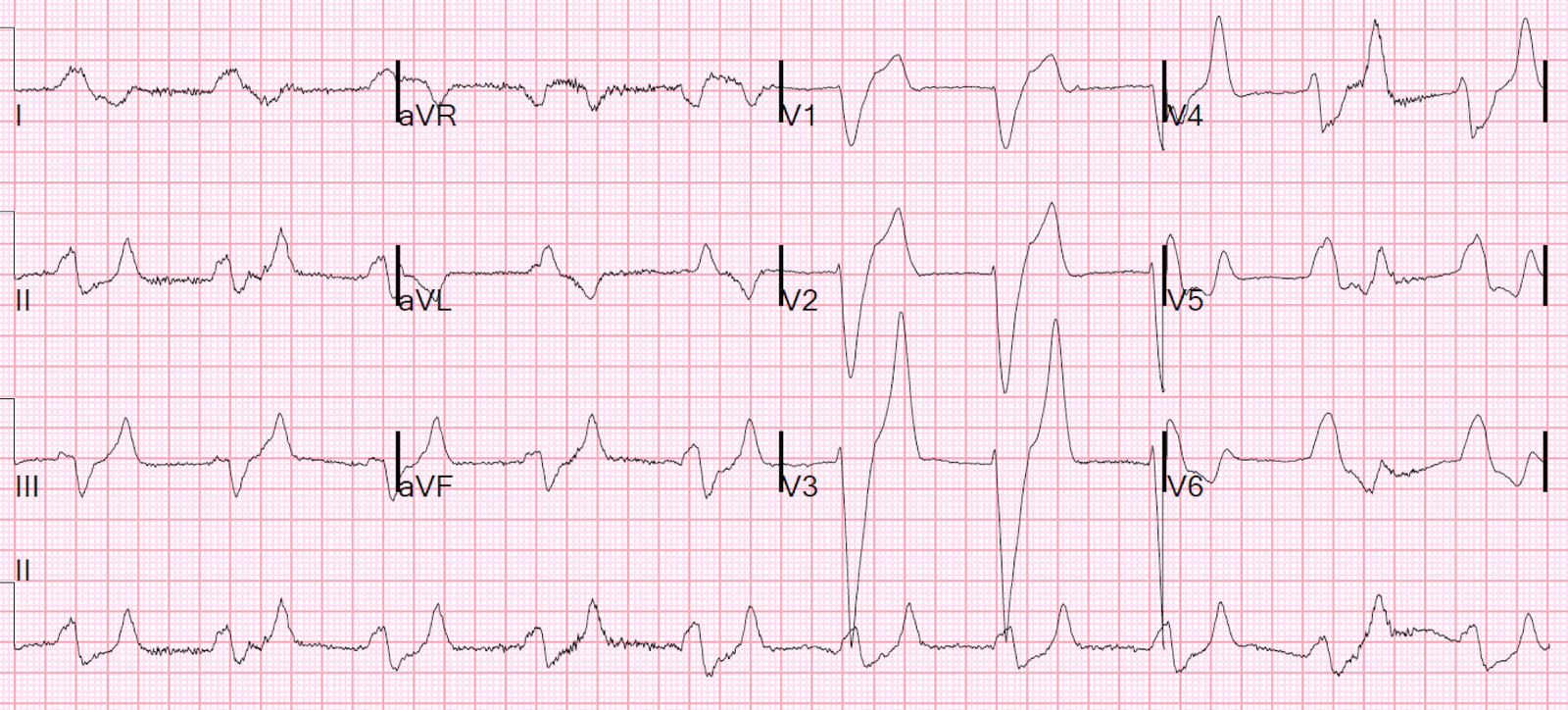 |
| It is slow and regular. There are no P-waves. So it is junctional rhythm or a right bundle escape, mimicking LBBB (Or it is sinus with a hidden P-wave).At first glance, it appears to have Left Bundle Branch Block (LBBB), with rS in right precordial leads and wide monophasic R-wave in I, aVL, V5 and V6. Third criterion positive in modified Sgarbossa! Notice The computer measurement of 218 ms is correct. A previous ECG was found and was normal. |
Remember that hyperkalemia causes PseudoSTEMI STE in V1 and V2.
See this case:
“Steve, what do you think of this ECG in this Cardiac Arrest Patient?”
In this case today, that pseudoSTEMI pattern is added to a pseudo-LBBB to result in a modified Sgarbossa false positive morphology!
LBBB and QRS duration
In this study of consecutive patients with LBBB who were hospitalized and had an echocardiogram, 13% had a QRS duration greater than 170 ms, and only 1% had a duration greater than 190 ms.
Clinical Course
The clinicians recognized this as hyperkalemia. The lab result was too high to measure (greater than 9.4 mEq/L).
The patient received albuterol x 6, calcium gluconate x 5 g, D50 (50 ml) x 2, 5 units regular insulin, 40 mg furosemide, and 50 mL of Na bicarb.
It turns out he had been told several days earlier that his K was low and so he had eaten several baked potatoes. Baked potatoes have about 926 mg of K (boiled potatoes have 296 milligrams, and an average banana has 426 mg). KCl is 74 mg per mEq, so the number of milliequivalents is far less, but a dialysis patient eating many baked potatoes is sufficient to substantially raise the K.
After dialysis, this was the followup ECG:
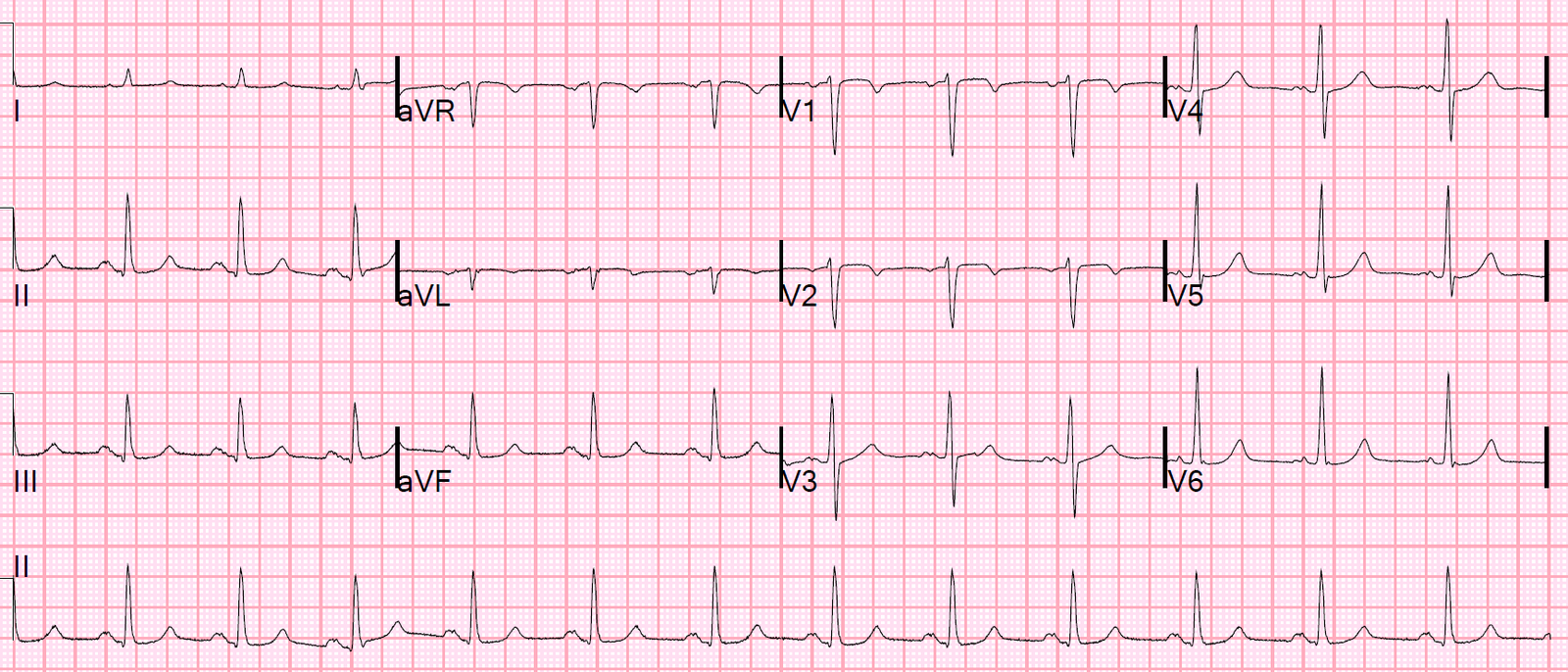 |
| Normal, except V1 and V2 are recorded too high on the chest (fully negative P-wave in V1, negative P-wave in V2) and there is slight ST depression. |