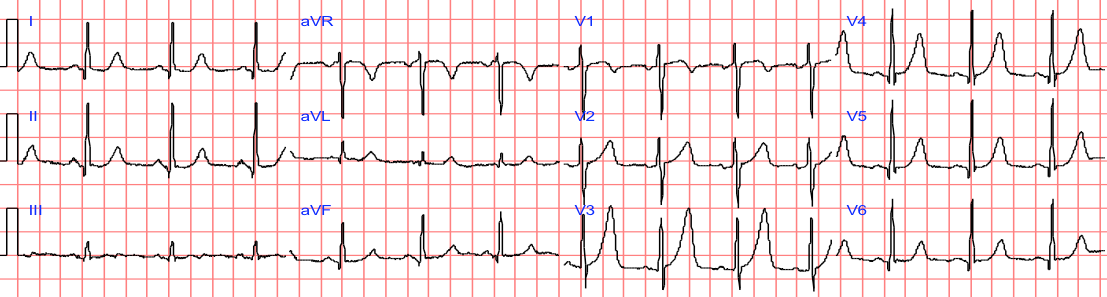
A 21 year old presented with typical chest pain. Here is his ECG:
 |
| There is inferior and lateral ST elevation. Pericarditis, right? |
The key to this being STEMI is the ST depression in V2, and perhaps a touch in aVL. This is very nearly a de Winter’s T-wave. ST depression is not seen in pericarditis, though it can be seen in myocarditis. Due to this ST elevation, one must assume that this is ischemic ST elevation.
There is saddleback, but the saddleback is in V3 and V4, not V2. More important is that there is ST depression, in which case saddleback morphology is NOT reassuring.
The emergency physician had to push for cath lab activation, but she was successful.
The LAD was full of thrombus and had aneurysms.
It was later found out that the patient had Kawasaki’s disease in childhood (the cause of the coronary aneurysms, inside of which thrombus formed).
Learning Points:
1. Young people do have MI
a. Some of these MIs in young people are due to anomolies: aneurysm from a disorder known to be associated with coronary aneurysms (left out to maintain anonymity) in this case. Young women, when they have STEMI, often have coronary dissection.
b. Nevertheless, even young people have atherosclerosis and plaque rupture. We have seen many, such as this young woman.
2. You diagnose pericarditis at your (and your patient’s) peril.
3. Pericarditis should not be diagnosed if there is reciprocal ST depression anywhere.
Some other cases:
Here is a 16 yo girl with STEMI
Here is a young man with STEMI diagnosis missed
Here is a 24 year old woman with massive anterior-inferior-lateral MI that could be erroneously mistaken for pericarditis (this is the one linked to above)