As you read this, remember that the PMCardio Queen of Hearts AI ECG Model is now FDA approved. Your patient need not sit around any more with dying myocardium, and your interventionalist need not be called in for false positives. The solution is here and available.
See more here: Queen of Hearts Now FDA Approved!! What’s her take on this “Non-diagnostic” ECG?
Case:
Sent by Dominik Poizl, a paramedic and ED nurse somewhere in Europe.
A 58 y.o. male presented to the ED for crushing/pressure like chest pain radiating to both arms and back, worse on inspiration and movement. Chest pain was intermittent for a week. Today the chest pain peaked and stayed at that intensity. The pain was associated with dyspnea — so he decided to visit our ED.
- History of hypertension and smoking.
- Sometimes has back pain — but “it´s different this time”.
- The patient hadn´t seen his GP in ~20 years. However, he went to a GP few days prior — was only prescribed pain meds and referred to specialists.
- The patient was immediately triaged upon arrival as an ACS suspicious patient at 14:19.
Smith: Even with a normal ECG, it is reasonable to take this patient to the cath lab because the clinical pretest probability is so high.
- Vital signs were within normal limits.
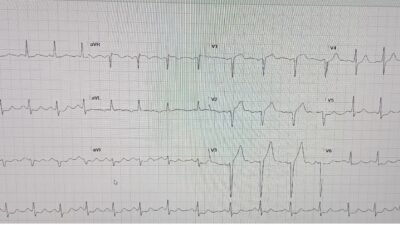
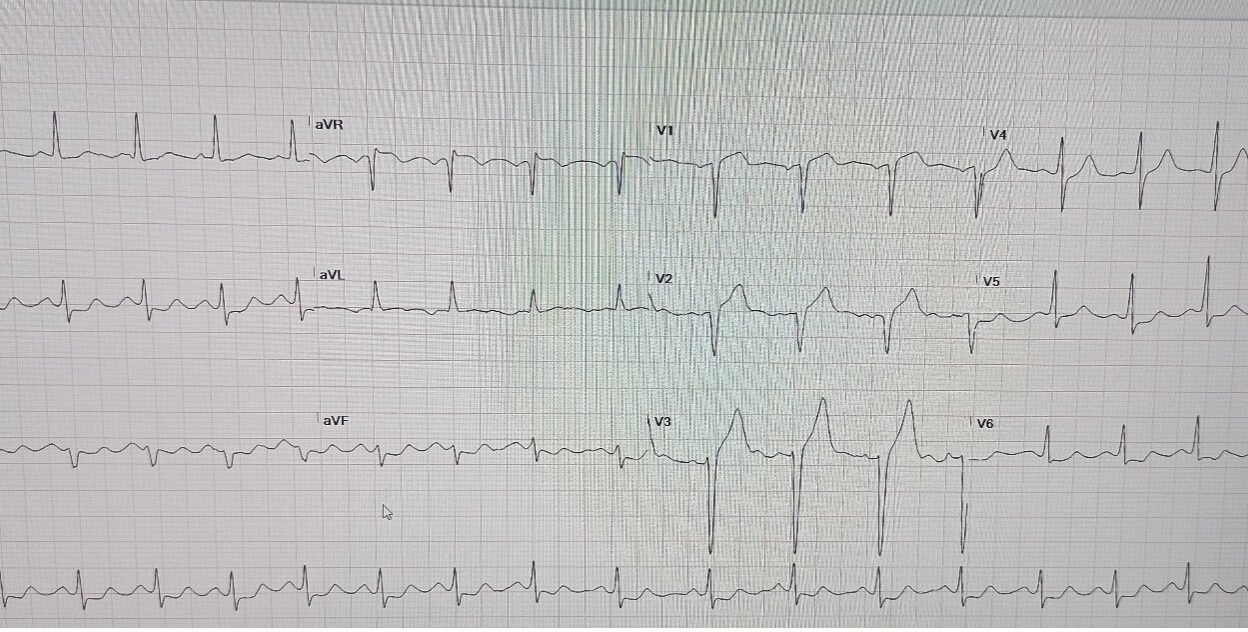
- First ECG obtained at 14:24; no previous ECG available:
— What do you think? —
= = =
= = =
= = =
Dominik writes: “To me this screams precordial swirl with SEI.”
Smith: STEMI millimeter criteria are not met. But this is classic precordial swirl: hyperacute T-wave in V2, STE in V1-2, with ST depression in V5-6. Remember that ANY ST elevation in V2-4 is ischemic if there is ANY ST depression anywhere else except for aVR. There is also ST depression in all inferior leads, and some very subtle coved STE in aVL. So this is diagnostic of proximal LAD occlusion.
- Dominik goes on to say: “In our facility, all chest pain ECGs with ACS symptoms are put into PMcardio ASAP.”
= = =
What does the PMcardio Queen of Hearts AI ECG Model say?
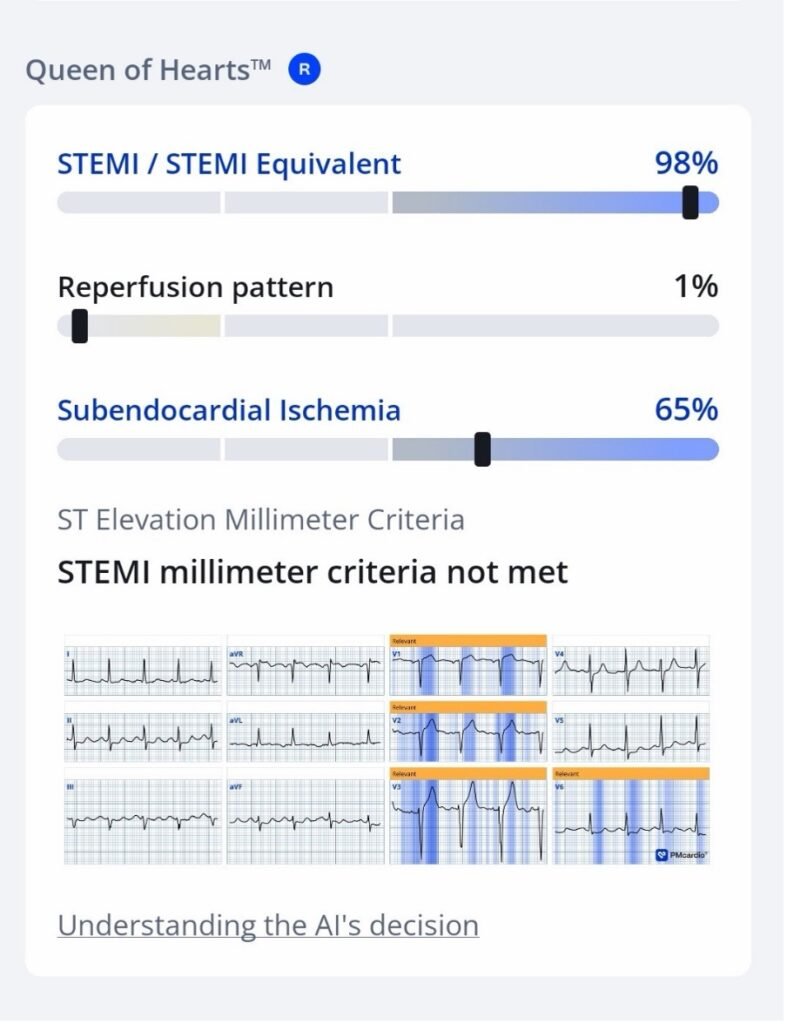
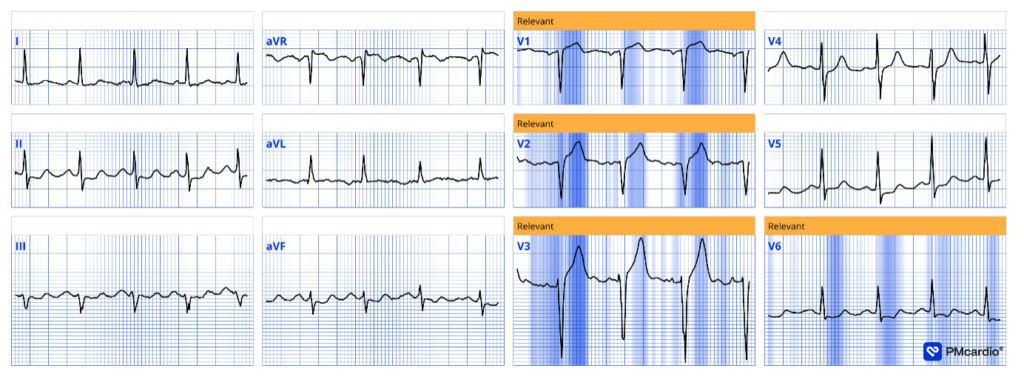
A better image of explainability:
So he consulted the cardiologist at the referral center, as he does not have privileges to activate the cath lab himself.
And what was the response of the cardiologist? It was a variation of the theme: “Doesn’t meet STEMI criteria”.
- Here it is, as Dominik writes: “Cardiologist at the PCI facility was consulted. He described the ECG as ‘subtle’ changes” — and told me to, “Treat per ACS protocol. No intervention needed as of now.”
- “Trend troponins and serial ECGs.”
Translation: “Let’s wait until the myocardium is dead. Then we will be certain that it is an acute MI. Then we can treat it after the damage is done.”
- Patient received 5000 units of heparin, 180mg tigagrelow, no ASA as he was already taking it.
- First troponin T returned below the URL at 11.3 ng/L. Patient received magnesium, guajacaran-guaifenesin and diclofenac without pain resolution.
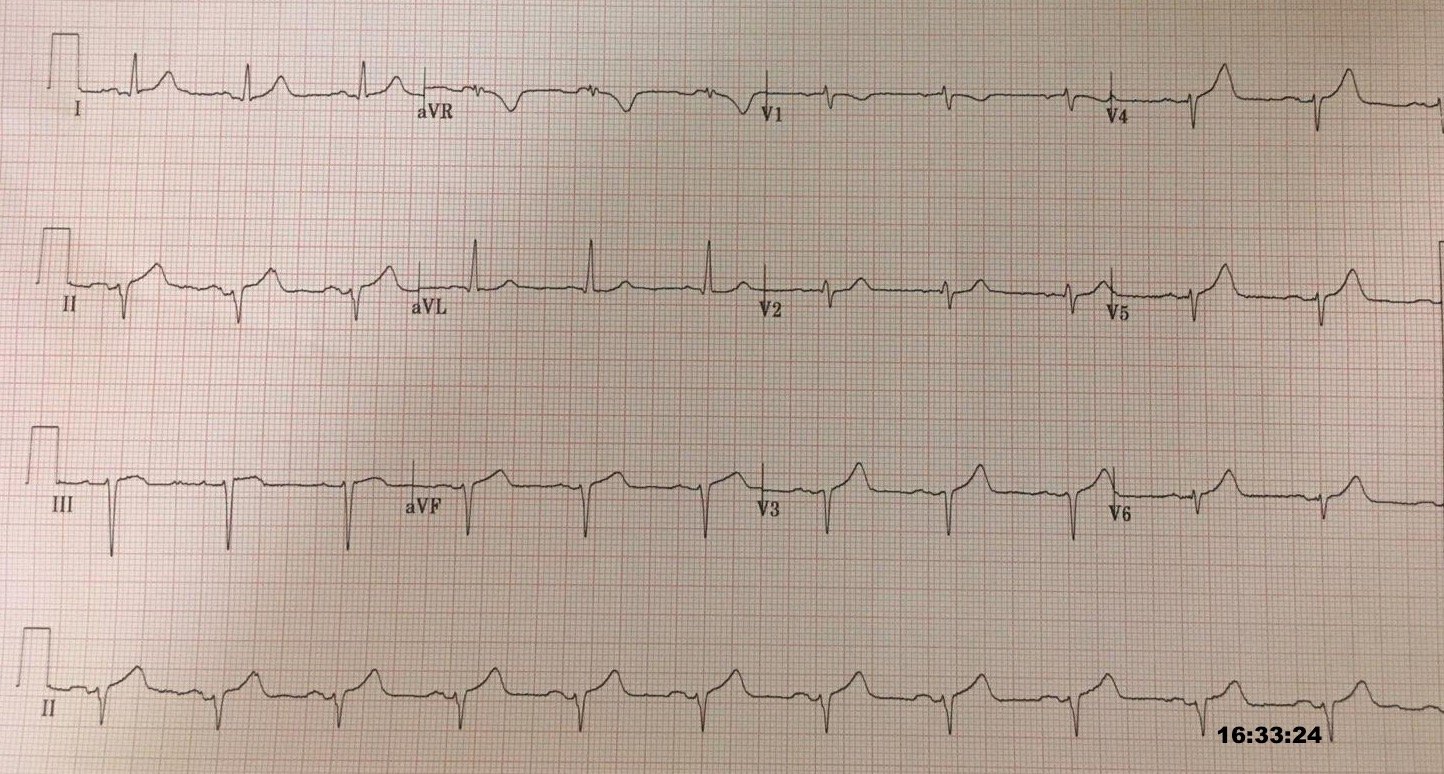
At 18:26, 4 hours after the first ECG — the patient described resolution of his pain.
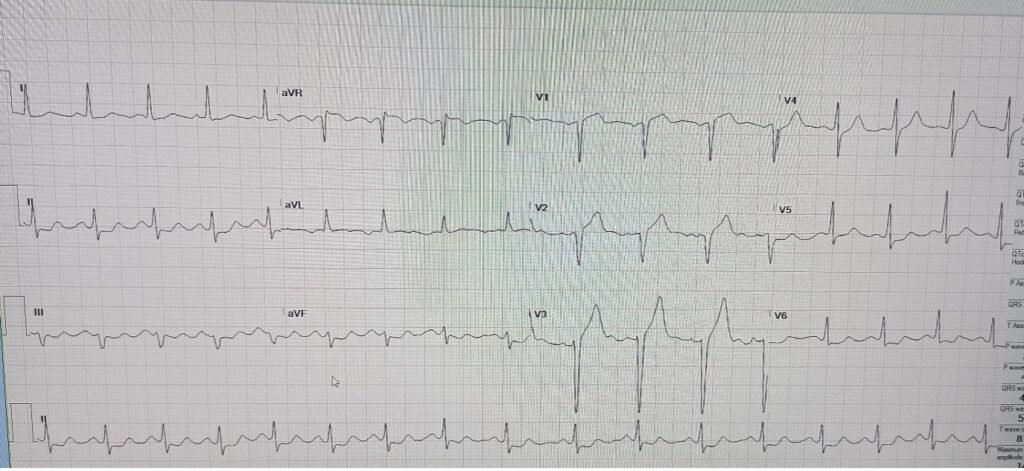
- Another ECG was recorded:
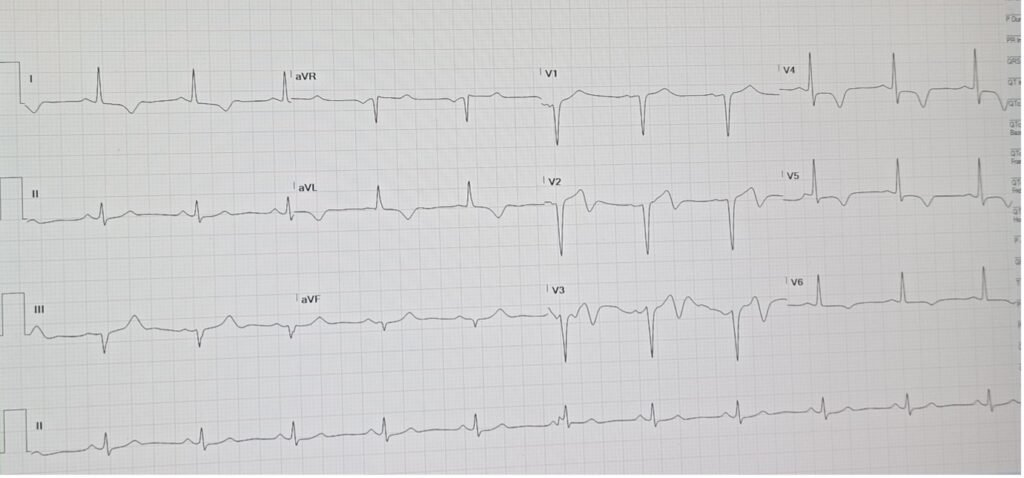
Dominik writes: “Wellens’ Syndrome”
Smith: The ECG shows reperfusion, supported by resolution of pain. The exact Wellens’ Syndrome is not as easy to diagnose as we have here — because in Wellens’ Syndrome, there is no ECG recorded at the time of the pain (as it is in this case).
- Here is the Queen of Hearts (“reperfusion pattern”):
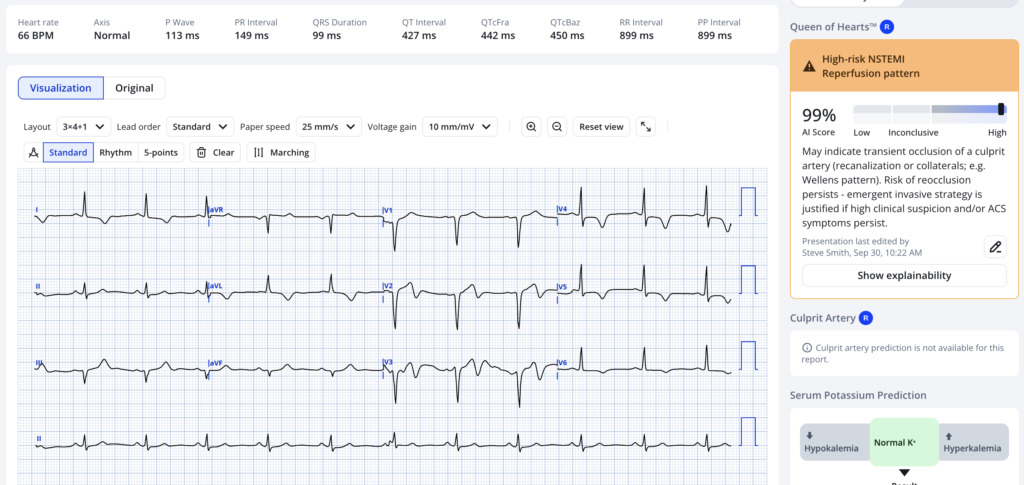
Second troponin T before reperfusion returned at 172 ng/l.
- The cardiologist was reconsulted, and agreed that an intervention is needed at 19:17.
PCI showed Ramus Intermedius with occlusion with two DES stents placed, TIMI flow before and after are unknown at this time.
- “Occluded” at angiogram usually means TIMI-0 or TIMI-1 flow, which implies that reperfusion is through collaterals. It is a strange fact that often collaterals open up during occlusion and result in reperfusion of the myocardium.
In this case, ironically, it wasn’t full occlusion/ischemia (active pain and active OMI on the first ECG) that convinced the interventionalist to go to the cath lab. It was only after reperfusion, when the myocardium was relatively spared, that the interventionalist recognized the emergency.
- So the interventionalist was concerned about reperfusion, but not about active occlusion!!
- In the meantime, the patient lost up to 4 hours of myocardium.
Had the interventionalist paid attention to the astute ED clinicians, and to the Queen of Hearts, the artery would have been opened far earlier and saved some myocardium. AND the interventionalist would have been able to do it during business hours!
Dominik: “This patient waited for total of 5 hours for a cath lab admission, which should have been immediate after the first ECG!”
= = =
==================================
MY Comment, by KEN GRAUER, MD (10/1/2026):
The scenario in today’s case is this:
- A 58yo man presents to the ED for a “crushing pressure” description of CP (Chest Pain) radiating to both arms and back that has been intermittently present for a week.
- Today the CP peaked and stayed at that intensity (in association with shortness of breath) — and that is what brought the patient to the ED.
- And the above history is from a patient whose initial ECG I’ve reproduced below in Figure-1.
= = =
KEY Point: The question has to be asked IF the above scenario and accompanying initial ECG was presented to any emergency provider (paramedic, nurse, ED physician, cardiologist) — What the approach to management should be?
- The simple answer to the above question should be obvious ==> Activate the cath lab!
- The more layered response to this question would raise the question as to what may have happened when? — as the patient’s symptoms began a week earlier (and there are QS complexes in leads V1,V2 of ECG #1 — with no more than the tiniest of r waves in lead V3).
Yet shouldn’t the seemingly inescapable answer to the above question be? ==> Activate the cath lab! The intensity of this patient’s crushing CP is maximal (and has been all day) — in association with his triage ECG that is shown in Figure-1. As per Drs. Poizl and Smith:
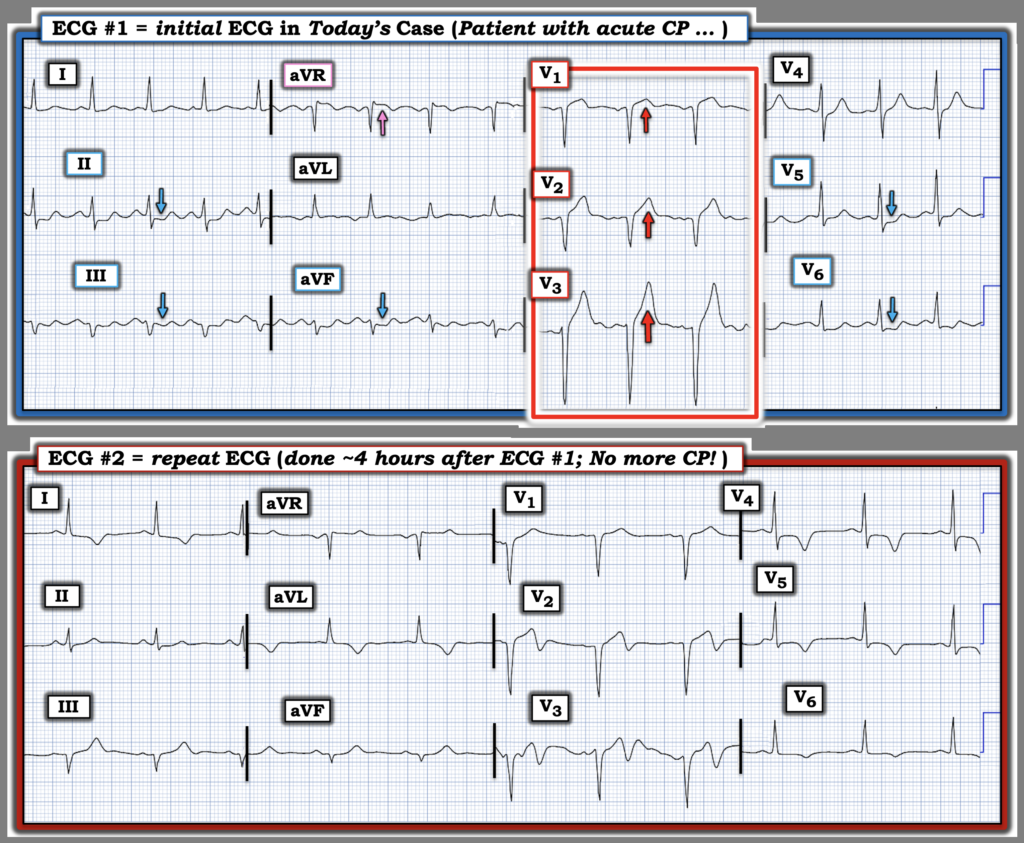
- There are “eye-catching” hyperacute ST-T wave changes in leads V1,V2,V3 of ECG #1 (within the RED rectangle) including:
- ST segment straightening and subtle-but-clearly abnormal ST elevation in lead V1.
- Overly “bulky” and disproportionately increased T wave in lead V2 (compared to the small size of the S wave in this lead).
- Disproportionately tall ( ==> hyperacute) T wave in lead V3.
- Criteria for Precordial “Swirl” pattern clearly satisfied by hyperacute anterior lead ST-T waves in association with ST depression in leads V5,V6 (BLUE arrows in these leads) — with full review of this important-to-recognize ECG pattern discussed in the October 15, 2022 post.
- Criteria for DSI (Diffuse Subendocardial Ischemia) clearly met by additional marked ST depression in leads II,III,aVF — in association with ST elevation in lead aVR.
The seemingly inescapable Impression: The patient continues to have severe CP in association with a triage ECG that is diagnostic of acute proximal LAD occlusion (which is what the Precordial “Swirl” pattern tells us) ==> Activate the cath lab now! (on the basis of this straight-forward history and this initial triage ECG).
- Proof of the above impression was forthcoming not only from cardiac cath findings — but from the repeat ECG shown below (despite the lead V3 artifact — diffuse reperfusion T waves confirming the extent of myocardium lost by the 4+ hour delay inproviding the needed treatment).
= = =
Figure-1: Comparison between the 2 tracings in today’s case (To improve visualization — I’ve digitized the original ECG using PMcardio).
= = =
= = =